
By: Francesca Mundrick, Founder of R4R
On a fairly hot Saturday morning in September, one of my past students called me on the phone. He said, do you want to go out to museums today? Going to museums is one of my most favorite ways to spend a day- there is nothing like coffee and slow strolls through historical exhibits. I had promised him before graduation that I would take him out in Philadelphia some day soon. That some day had arrived. We both made a plan to set out at 9am- headed first for the halls of the new Museum of the American Revolution on 3rd Street.
My PhD work has much to do with understanding the societal, social, cultural, and historical factors that make up our current relationship with the natural world. As a Geographer, my view on nature, and how to safeguard it, is sociological.
I have been exploring the ideas that built America for some time now because I believe that these foundational philosophies can allow us to better define and practice modern sustainability and conservation. Localism, liberty, stewardship, optimism, freedom, and even free market economics. Instead of searching endlessly for something new, we should realize that we already have the ingredients for success.

With this context in mind, it is understandable why I wanted to explore the new Museum of the American Revolution. I needed inspiration and it did not disappoint.
As we moved through the first rooms of the museum, exploring the deeper historical puzzle pieces of the English-Colonial relationship, we reached a room on the beginnings of colonial revolutionary resistance. At the very center of the room was an enormous replica tree. I immediately went right to it- curious. The tree represented colonial “Liberty Trees” a concept born from the role of old growth trees in revolutionary culture.
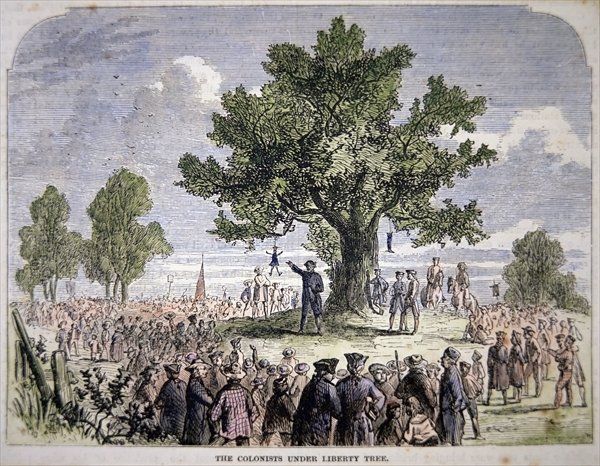
In the early days of the revolution, when sharing the idea of freedom mattered most, colonists used trees as meeting places to protest, plan resistance, harness rebellion, and forge hope. For generations before the American Revolution, trees, especially large, old trees, were utilized as natural landmarks where meetings could be held to organize the community.
Not only used for utilitarian purposes, trees were seen as symbolically powerful. Historian Alfred R. Young notes that “English lore contains stories of trees tied to political events and were venerated.” Trees were seen as wise old friends over generations of fights for change.
As trees grow older, they get taller and wider. Rings, over rings, over rings stack and stack and stack to widen a tree’s base as it grows. An old tree is not just big, it has seen years of history- holding a spiritual, ancient power. Across cultures, trees are seen as value life forms that offer resources and create connectivity in local spaces.
One of the first organized causes within the American Revolution was the protest of the Stamp Act- taxes ordered from the English Crown on printed goods. In 1765, the Loyal Nine, a band of patriots that would become the Sons of Liberty, began to plan protests against the Stamp Act. Their meetings were hosted at an old elm tree on the corner of what is now Essex and Washington Streets in Boston. Eventually, due to its significance to the cause of freedom, a copper plate soon appeared on the tree, declaring it the “Tree of Liberty.”
From 1765 to 1775, the Boston Liberty Tree saw many significant protests that were foundational to the revolution with calls to action posted around the town calling for Bostonians “to meet at the Liberty Tree…..”

Boston’s Liberty Tree was just one of many Liberty Trees throughout the 13 Colonies. The folklore of these symbolic plants moved far beyond the newly forming United States to worldwide audiences.
In 1775, the Liberty Tree was cut down by occupying British soldiers and used as firewood. Their act was intended to destroy a powerful symbol of resistance, protest, and revolution. After the Revolution, Boston designated the stump of the Liberty Tree as the Liberty Stump. For unknown reasons, the stump is no longer here today.
In 1825, the Marquis de Lafayette, a Frenchman and key player in the success of the American Revolution, was on a farewell tour of the visited the United States. And the Marquis knew exactly what he wanted to see in Boston—a tree stump. Lafayette believed the stump to be a “potent symbol of freedom and rebellion” . Even as a stump, the place where Boston’s Liberty Tree had once stood held special significance.
The United States has always been known for its rebellious, spirited people and its wild nature. It is no shock that the ancient trees of our early Colonies played such an important role and forged such a spirit of change. The growth of a tree is symbolic to the growth of a cause- it is living and breathing.
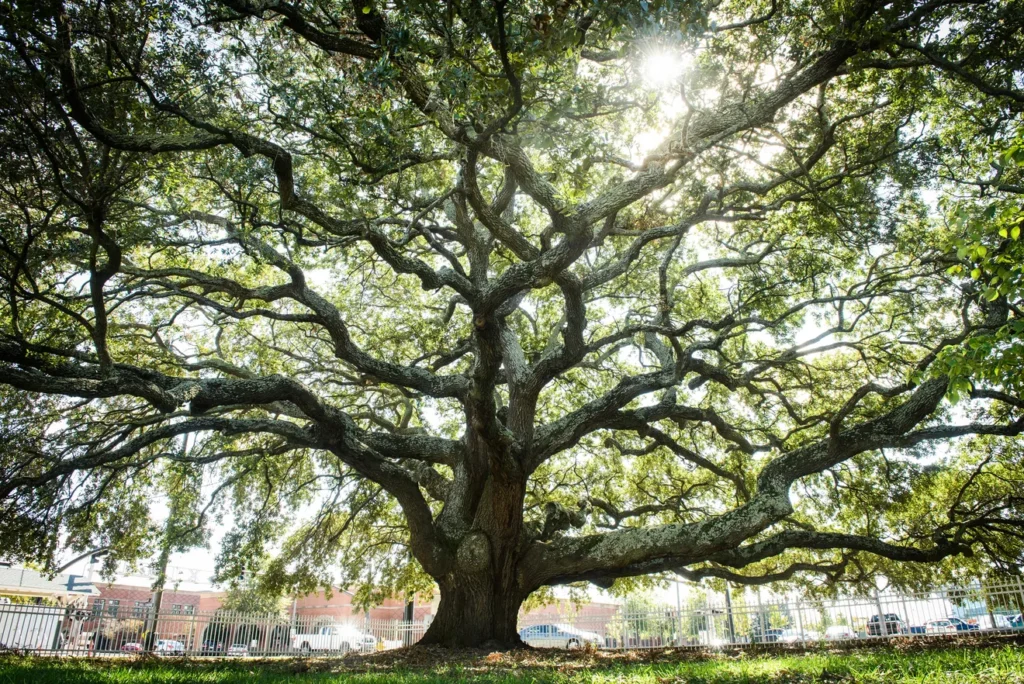
Trees are often the most contested beings of nature within communities. Many things are said about trees. Trees are hazards due to weather. Tree roots rip up concrete and get into foundations. Trees are considered a nuisance for their leaf litter. Trees are seen as gaudy parts of landscapes.
Trees offer us many benefits- that far out way their perceived cons. Trees are carbon sinks, provide oxygen via photosynthesis, and create cleaner air. Trees manage stormwater and balance run off in developed areas. Trees create shade- lower temperature outside and inside homes. Trees add to the character of communities and increase real estate costs. Beyond these ecological pros, trees are a valuable part of our American history, their life force is woven into the story of liberty in our society and culture.
Consider the trees on your property and in your community. What have they seen in their lifetime? Did willful colonists congregate under them to spread words of freedom? Consider hosting your next community meeting under the shade of a tree.
Perhaps it is better to keep all of the trees on your property- you do not want to be like the British chopping down all the Liberty Trees.
To an America wild and free,
Franny
 Rewilding4Republicans
Leave a comment